Francais
 Cart
Cart Quote
QuoteLaboratory trays and containers: how to choose based on chemical constraints?
In analytical, research, or quality control laboratories, the choice of trays and containers is critical. This guide helps you select the right material for each application to ensure safe handling.
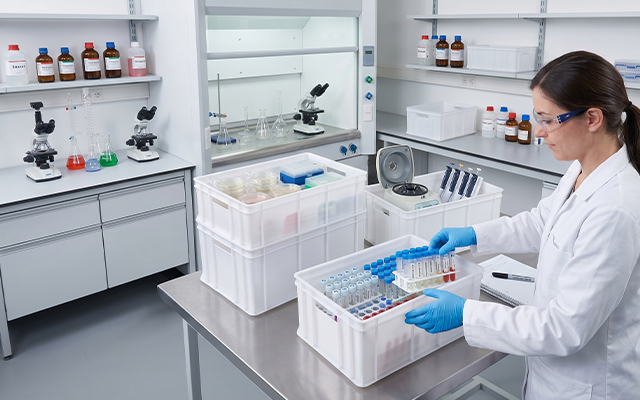
Insufficient chemical resistance, migration of contaminants, deformation under heat, or degradation caused by solvents: choosing the wrong container can compromise analytical reliability, contaminate valuable samples, and in the most severe cases, pose risks to operators.
Why is chemical resistance critical?
Unlike the food industry or standard industrial logistics, laboratory environments involve contact with chemicals with highly varied properties: concentrated acids, strong bases, organic solvents, and powerful oxidizers. Each plastic material has a specific tolerance to these agents, depending on concentration, exposure temperature, and duration of contact.
- Deform or crack, leading to hazardous leaks.
- Release plasticizers or residual monomers, affecting analytical results.
- Gradually degrade, resulting in loss of rigidity and sealing.
- Become opaque or discolored, masking visual detection of contamination.
Overview of materials and their applications
High-density polyethylene (HDPE)
HDPE is the most versatile plastic used in laboratories. It offers excellent resistance to diluted and concentrated acids (hydrochloric, sulfuric, nitric up to 30%), bases (sodium hydroxide, potassium hydroxide), bleach, and most alcohols. It is lightweight, impact-resistant, and cost-effective.
Limitations: not suitable for aromatic solvents (toluene, xylene) or halogenated hydrocarbons (DCM, chloroform). Thermal limit around 80 °C.
Typical uses: spill containment trays, washing trays, diluted acid containers.Polypropylene (PP)
Polypropylene offers slightly lower resistance than HDPE to highly concentrated acids but withstands higher temperatures (up to 100–120 °C intermittently) and is compatible with steam sterilization (autoclaving). It is the preferred material for containers exposed to heat treatment.
Typical uses: autoclave trays, centrifugation containers.Polyvinylidene fluoride (PVDF)
PVDF provides outstanding chemical resistance, particularly to aggressive organic solvents (acetone, DMF, NMP), strong oxidizers (concentrated nitric acid, hydrogen peroxide), and halogens. It can be used at temperatures up to 140 °C. Its cost limits it to critical applications.
Typical uses: containers for concentrated acids, halogenated solvents.Polytetrafluoroethylene (PTFE or Teflon)
PTFE offers the broadest chemical resistance available. It is inert to almost all chemicals. Its ultra-smooth surface minimizes adsorption of target molecules, making it ideal for trace analysis.
Typical uses: aggressive chemistry, trace analysis containers.Polycarbonate (PC)
Polycarbonate stands out for its excellent optical transparency, enabling easy visual inspection. It is impact-resistant and suitable for aqueous environments but sensitive to strong bases, concentrated alcohols, and chlorinated solvents.
Typical uses: observation trays, aqueous media containers.| Material | Diluted acids | Concentrated acids | Strong bases | Organic solvents | Max temperature |
|---|---|---|---|---|---|
| HDPE | ✓✓✓ | ✓✓ | ✓✓✓ | ✗ | 80 °C |
| PP | ✓✓ | ✓ | ✓✓ | ✗ | 110 °C |
| PVDF | ✓✓✓ | ✓✓✓ | ✓✓ | ✓✓ | 140 °C |
| PTFE | ✓✓✓ | ✓✓✓ | ✓✓✓ | ✓✓✓ | 260 °C |
| PC | ✓✓ | ✗ | ✗ | ✗ | 120 °C |
Selection criteria beyond material
Chemical resistance is the primary factor, but other parameters must be considered when choosing laboratory trays and containers.
- Capacity and geometry: For spill containment trays, capacity must be at least 100% of the largest container or 50% of the total stored volume.
- Sealing: For volatile substances, use screw or clip lids with PTFE or silicone seals.
- UV resistance: Light-sensitive reagents require opaque or amber containers.
- Identification: Prefer containers with labeling areas or writable surfaces.
Spill containment trays: a regulatory requirement
In any laboratory handling hazardous chemicals, spill containment trays are a legal requirement (labor code, ATEX, REACH). They must be placed under any liquid storage likely to leak. The tray material must be compatible with all stored products:
- HDPE for acids, bases, and inorganic salts.
- PP for heated products.
- PVDF or PTFE for halogenated solvents and concentrated acids.
Maintenance and service life of laboratory trays
Even high-quality trays must be regularly inspected. Signs of aging include yellowing, embrittlement (microcracks), permanent deformation, absorption marks (swelling), and any change in internal surface condition. When in doubt, preventive replacement is always recommended.