Francais
 Cart
Cart Quote
QuoteMultiroir and Fundamental Rights: Our Commitment to Responsible Trade
In a context where companies are increasingly expected to have a positive social and human impact, beyond their sole economic performance, Multiroir chooses clarity and transparency. This article presents the fundamental commitments that guide our daily practices: respect for the principles of the International Labour Organization (ILO) and the rights proclaimed by the Universal Declaration of Human Rights (UDHR) of 1948.

1. Reference Texts: ILO and UDHR, Two Universal Pillars
The Universal Declaration of Human Rights (1948)Adopted by the United Nations General Assembly on December 10, 1948, the UDHR is the founding text of the inalienable rights of every human being, regardless of nationality, gender, religion, or origin. For a company, referring to it means recognizing that its activities can never be carried out at the expense of the fundamental rights of individuals, whether they be its employees, its suppliers, or the communities in which it operates.
Among the rights directly applicable to our business activity are in particular: the right to just and favorable conditions of work (Article 23), the right to an adequate standard of living (Article 25), the right to education and training (Article 26), and the prohibition of all forms of slavery or forced labor (Article 4).
The ILO Declaration on Fundamental Principles and Rights at Work
The International Labour Organization, founded in 1919, is the specialized agency of the United Nations whose mission is to promote decent work for all. Its 1998 Declaration on Fundamental Principles and Rights at Work defines four categories of rights that all Member States and, by extension, the companies operating within them, must respect, regardless of their level of development:
- Freedom of association and the effective recognition of the right to collective bargaining: every worker has the right to organize, to join a union, and to bargain collectively for their working conditions.
- The elimination of all forms of forced or compulsory labor: no worker can be forced to work under the threat of a penalty or sanction.
- The effective abolition of child labor: the use of child labor, particularly in its worst forms, is an unacceptable violation of fundamental rights.
- The elimination of discrimination in respect of employment and occupation: every worker must benefit from equal treatment and opportunity, without discrimination based on gender, origin, religion, disability, or any other personal characteristic.
2. How Multiroir Translates These Principles into Practice
2.1 Within Our Company
Working Conditions and Fair Remuneration
Multiroir ensures it provides all its employees with working conditions that comply with French legislation—one of the most protective in Europe—and goes beyond legal minimums whenever possible. Remuneration is established without discrimination based on gender, age, or origin. We conduct regular salary reviews to identify and correct any unjustified discrepancies.
Health, Safety, and Risk Prevention
Workplace safety is a non-negotiable priority. Our Single Occupational Risk Assessment Document (DUERP) covers all positions. Risks related to handling (MSDs, falls, carrying loads...) are addressed through specific preventive measures: provision of ergonomic equipment, workstation layout adjustments. Zero serious accidents is our operational goal.
Freedom of Association and Social Dialogue
Multiroir fully respects its employees' rights to unionize and be represented. Employee representative bodies meet regularly in compliance with legal obligations. Social dialogue is viewed as a lever for performance and trust, not as a constraint.
Non-Discrimination and Equal Opportunity
Our recruitment process is based on skills and aptitudes, regardless of age, gender, origin, disability, or any other protected personal characteristic. We are committed to a professional gender equality policy and promote the inclusion of workers with disabilities.
Training and Skills Development
In accordance with Article 26 of the UDHR, which affirms everyone's right to education, we invest in the continuous training of our teams. Skills development plans, access to professional training, and support for career advancement: we consider employee progression to be a shared responsibility between the company and the employee.
2.2 In Our Supply Chain
The principles of the ILO and the UDHR do not stop at our company doors. As a buyer, we have a responsibility across our entire supply chain. A product offered at an abnormally low price may conceal production conditions that violate workers' fundamental rights (forced labor, lack of social protection, dangerous conditions).
Ethical Supplier Selection
Multiroir integrates social and ethical criteria into the selection and evaluation of its suppliers. We favor partners who can demonstrate compliance with fundamental labor standards in their own operations. We plan to implement an assessment in the form of a CSR questionnaire before listing any new suppliers.
Vigilance Regarding Child and Forced Labor
In compliance with the French law on the corporate duty of vigilance (Law No. 2017-399 of March 27, 2017), we have established a vigilance plan aimed at identifying and preventing serious risks of human rights violations in our supply chain, particularly the risks of child or forced labor among our Tier 1 suppliers.
Preference for European and Local Suppliers
Whenever possible, we direct our purchases toward suppliers whose social standards are verifiable and high. Geographical proximity is a criterion that facilitates the verification of production conditions and simultaneously reduces the carbon footprint of our supply chain.
3. Our Complementary Environmental Commitments
Human rights and the environment are inseparable: the degradation of ecosystems primarily affects the most vulnerable populations. This is why our CSR commitment also includes a strong environmental dimension, consistent with the "Environment" pillar of the EcoVadis rating.
Reducing Our Logistics Carbon Footprint
Optimizing our delivery routes, pooling shipments, and reducing the number of over-packaged items are ongoing projects. We are working to reduce "empty miles" in our delivery fleet and to develop grouped delivery solutions for our professional clients.
Responsible Packaging Policy
We are progressively reducing unnecessary plastic packaging in our shipments, replacing it with recyclable or reusable materials. The products themselves (bins, pallet boxes, roll containers...) are selected based on their durability and end-of-life recyclability, in line with a circular economy approach.
Energy Efficiency
Our warehouses and premises undergo regular monitoring of their energy consumption. LED lighting, thermal regulation, and consumption tracking by workstation are measures that have already been deployed. Our medium-term objective is to reduce our energy intensity (consumption relative to revenue) year after year.
4. Correspondence Table: Our Commitments and Frameworks
| Reference Principle | Source Text | Implementation at Multiroir |
|---|---|---|
| Prohibition of forced labor | ILO Conv. 29 & 105 / UDHR Art. 4 | Supplier contractual clause, vigilance plan |
| Abolition of child labor | ILO Conv. 138 & 182 / UDHR Art. 25 | Supplier selection criterion, CSR questionnaire |
| Non-discrimination in employment | ILO Conv. 100 & 111 / UDHR Art. 2 & 23 | Gender equality policy, objective recruitment process |
| Freedom of association | ILO Conv. 87 & 98 / UDHR Art. 20 & 23 | Representative bodies, regular social dialogue |
| Decent working conditions | ILO / UDHR Art. 23 & 24 | DUERP, ergonomics, training, fair remuneration |
| Right to education | UDHR Art. 26 | Annual skills development plan |
| Environmental protection | UN SDGs / EcoVadis Env. pillar | Green logistics, responsible packaging, energy |
| Responsible purchasing | ILO / 2017 Duty of Vigilance Law | Supplier CSR assessment, local preference |
5. Our EcoVadis Approach: A Certification, A Commitment to Progress
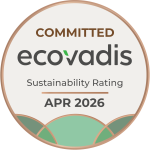
The EcoVadis "Committed" badge obtained by Multiroir in April 2026 validates the reality of our commitments through an independent, rigorous, and documentary evaluation. EcoVadis analyzes not our intentions, but our evidence: written policies, procedures, monitoring indicators, and demonstrated actions.
This badge is a milestone. Our ambition is to progress on each of the four pillars during the next evaluation cycle:
- Environment: formalized carbon footprint, quantified reduction targets.
- Labor & Human Rights: strengthened monitoring of social indicators, ILO training for managers.
- Ethics: formalization and distribution of our supplier code of conduct.
- Sustainable Procurement: extension of the CSR evaluation to Tier 2 suppliers.
Multiroir's Commitments
- Respect for the 8 fundamental ILO conventions
- Adherence to the principles of the Universal Declaration of Human Rights
- Vigilance plan against forced and child labor
- Non-discrimination and professional equality policy
- Respected and valued social dialogue
- Environmental approach: packaging, energy, logistics
- Ethical supplier selection
- EcoVadis "Committed" Certification - April 2026
Conclusion
Multiroir is a commercial enterprise, but not only that. We are convinced that economic performance and respect for human rights are not mutually exclusive; they reinforce each other. An employee whose dignity and rights are respected is an engaged employee. A supplier with ethical practices is a reliable long-term partner. A customer who chooses a responsible supplier strengthens their own CSR approach.
It is in this spirit that we publish this article: not as a communication exercise, but as a public and verifiable declaration of our commitments, open to critique and continuous improvement.
Discover our comprehensive CSR approach
Would you like to know more, consult our vigilance plan, or integrate our EcoVadis data into your supplier reporting?
Contact our CSR team