Francais

 Cart
 Quote
Professional Packaging EPR: Everything You Need to Know Before January 1, 2027
Extended Producer Responsibility (EPR) applied to professional packaging, known as the EPRO sector, is changing how French companies finance the end-of-life of their packaging. Initially scheduled for July 1, 2026, its entry into force has been postponed to January 1, 2027. Three eco-organizations have been approved, and the fee schedules are becoming clearer: here is how to identify your obligations, calculate your eco-contribution, and take action without delay.

What is the professional packaging EPR?
The EPR (Extended Producer Responsibility) stems from the "polluter-pays" principle: the company that places a product on the market finances its management when it becomes waste. Established for professional packaging by the French AGEC Law of February 2020, the EPRO sector is organized by Decree No. 2025-1081 of November 17, 2025, and a specifications document set by order on December 2, 2025.
In concrete terms, companies classified as "producers" must join an approved eco-organization, declare the packaging they put on the market, and pay an eco-contribution (eco-fee). In return, the eco-organization finances and structures collection, sorting, reuse, and recycling. The framework has already been operating since March 2024 for catering packaging; it will be extended on January 1, 2027, to all professional packaging.
Why a new framework?
According to the French Ministry of Ecological Transition, approximately 12.5 million tons of packaging are placed on the market and discarded each year in France, of which nearly 7 million tons are linked to professional activities. For professional plastic packaging, only about a quarter is currently recycled.
The goal goes beyond financing recycling: the EPR is designed to guide purchasing decisions upstream. Through eco-modulation, bonuses and penalties will reward packaging that is reduced, reusable, or easily recyclable. The end-of-life cost thus becomes a decision-making criterion, alongside price, functionality, or logistics.
The timeline to remember
| Date | Milestone |
|---|---|
| February 2020 | AGEC Law: creation of the framework for professional packaging |
| March 2024 | Start of the EPR for catering packaging |
| November 17, 2025 | Decree No. 2025-1081 establishing the sector |
| December 2, 2025 | Order setting the specifications |
| June 2026 | Approval of Citeo Pro, Léko Pro, and Twiice (orders of June 3, 2026) |
| July 28, 2026 | Ministerial press release confirming the postponement of the launch to January 1, 2027 |
| Autumn 2026 | Publication of the 2027 fee schedules by the eco-organizations; registration recommended before December 31, 2026 |
| January 1, 2027 | Entry into force of obligations, without retroactivity |
| Early 2028 | First declaration, covering 2027 activity (dates specific to each eco-organization) |
Which packaging is affected?
The framework covers exclusively professional sales packaging, grouped (secondary) packaging, and transport packaging, as well as those expressly listed by the scope order. Depending on your activity, this may include:
- Cardboard boxes and shipping cartons, bags, stretch films, covers, and strapping;
- Pallets, pallet boxes, and handling bins;
- Jerrycans, drums, buckets, and industrial packaging;
- Intermediate Bulk Containers (IBCs).
Reusable packaging deserves special attention: their processing (declaration, reuse bonus) varies depending on the eco-organization. For example, Citeo Pro featured a −50% reuse bonus in its 2026 pricing guide. Be sure to check with the eco-organization you select.
Are you a "producer" under the EPR definition?
The status of "marketer" (metteur en marché) determines who must register and pay. You are concerned in the following cases:
- You make available a product falling within the scope of an EPR under your name or brand (manufacturer, distributor);
- You import for the first time into France a product subject to an EPR scheme (importer);
- You sell remotely, from a third country, directly to the final consumer (marketplace);
- You have packaging or a packaged product designed or manufactured under your brand or according to your specifications (contracting authority).
The 5 steps to compliance
Map your packaging flows
List your packaging by category (sales, grouped, transport), by material, with their unit weight and annual volumes, on both the purchasing and sales sides.
Qualify your status
Determine whether you are a producer, and who is responsible in your supply chain (you, your supplier, your principal).
Quantify your tonnages by material
This is the foundation of your declaration and the calculation of the eco-contribution.
Choose your eco-organization
Three are approved in France: Citeo Pro, Léko Pro, and Twiice. Compare fee schedules, services, and reporting procedures, then join, ideally before December 31, 2026.
Declare, pay, and justify
You will receive a Unique Identifier (IDU), which certifies your compliance and must appear on your general terms and conditions of sale (GTC).
How much will the eco-contribution cost?
The eco-contribution is calculated by weight, per material, and not by the number of units. As the 2027 schedules are expected in autumn 2026, here are the published 2026 schedules to give you an order of magnitude:
| Material | Citeo Pro | Léko Pro | Twiice |
|---|---|---|---|
| Plastic | €217.90/t | €217.80/t | €217.56/t |
| Paper-cardboard | €34.70/t | €34.72/t | €34.67/t |
| Wood | €9.00/t | €8.08/t | €8.98/t |
| Flat fee under 2 tons | €125 excl. tax/year | €95 excl. tax/semester | €100 excl. tax/year |
* 2026 schedules noted for informational purposes; verify the current values on the website of each eco-organization.
To illustrate: 10 tons of plastic packaging represent an eco-contribution of approximately €2,200, compared to roughly €350 for 10 tons of paper-cardboard. Eco-modulation will add bonuses and penalties, the terms of which are still being defined: monitor their financial impact as the framework rolls out.
How to sustainably reduce your eco-contribution?
- Lighten and reduce: less weight, less empty space, less cushioning packaging.
- Simplify materials: mono-material packaging is easier to recycle.
- Integrate recycled materials into your containers and handling equipment.
- Switch to reuse: replacing single-use packaging with reusable containers reduces the tonnages placed on the market and prepares for the objectives of the European PPWR regulation.
- Require reliable data from suppliers regarding composition, weight, and recyclability.
At Multiroir, several product lines meet this logic of reuse:
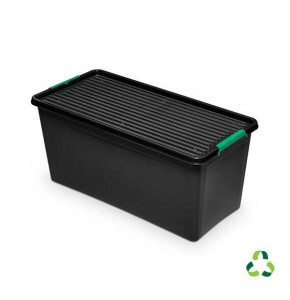
Euro-norm plastic boxes, distribution boxes and folding boxes, solid, perforated, folding pallet boxes or IBCs, plastic pallets, as well as an eco-responsible range including containers made from recycled materials. Designed to complete numerous rotations, these containers are concrete levers for replacing single-use packaging. Our team helps you choose the solution adapted to your flows.
EPR and PPWR: two texts, one direction
The French EPR fits into a broader European framework. The PPWR regulation (EU 2025/40) has been applicable since August 12, 2026, and sets requirements for recyclability, recycled content, and reuse by 2030. The EPR integrates several of its concepts: anticipating one means preparing for the other.
Find our detailed analysis in our dedicated article on the PPWR.
Frequently Asked Questions
When does the professional packaging EPR come into force?
On January 1, 2027, following a postponement from the initial date of July 1, 2026. There is no retroactivity.
Is a small business affected?
Yes, regardless of size, as long as it is qualified as a producer. Eco-organizations offer a minimum flat fee for low tonnages (under 2 tons).
What are the approved eco-organizations?
Citeo Pro, Léko Pro, and Twiice, approved in June 2026. You freely choose the one you join.
Can I transfer my obligations to my supplier?
This depends on the distribution of roles in your supply chain (brand, contracting authority, importer). Document your analysis and validate it with the eco-organization.
What should I do right now?
Map your flows, estimate your tonnages by material, and compare the 2027 fee schedules as soon as they are published.
Conclusion: Anticipate and optimize!
With only a few months left before the deadline, the professional packaging EPR requires a precise knowledge of your flows and status. Companies that anticipate will be able to control their eco-contribution and direct their purchases toward more sustainable packaging.
To rethink your containers and handling equipment sustainably...
Contact the Multiroir teamOr call us at +33 (0)1 45 10 15 20
Sources:
- ADEME – Professional packaging EPR sector
- Ministry of Ecological Transition – Professional packaging
- Huglo Lepage – Professional packaging EPR: postponed to January 1, 2027
- FFB – Professional packaging EPR: postponement confirmed
- EPR Representative – 2026 professional packaging EPR fee schedules