Francais
 Cart
Cart Quote
QuoteProfessional shelving: A strategic lever to secure your flows and maximise floor space
Often perceived as a simple logistical convenience, storage infrastructure plays a decisive role in business productivity. From industrial workshops to archive offices, spatial organisation directly impacts workflow efficiency, employee safety, and real estate cost optimisation. An in-depth look at an asset that deserves the full attention of decision-makers.

In an economic environment where every square metre counts and operational efficiency is closely monitored, storage can no longer remain static. It must become dynamic. Whether managing spare parts, finished goods, or administrative records, shelving is no longer just furniture: it is a management tool.
Flow management: The contribution of logistics standards
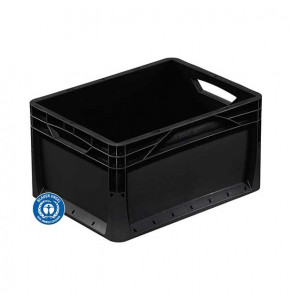
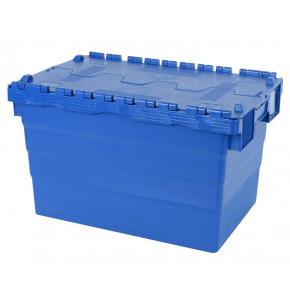
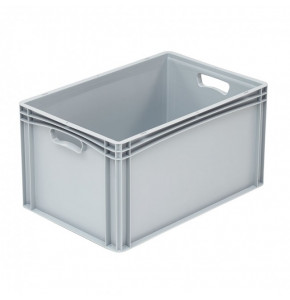
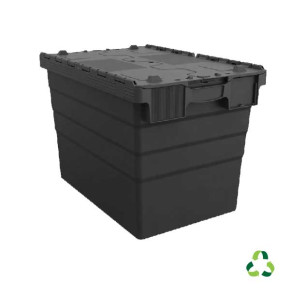
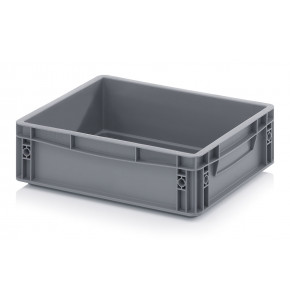
One of the primary levers for workspace optimisation lies in standardisation. Adopting standards such as the European format (600 × 400 mm) enables full interoperability across the logistics chain.
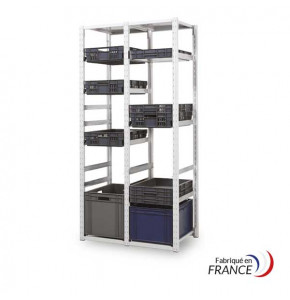
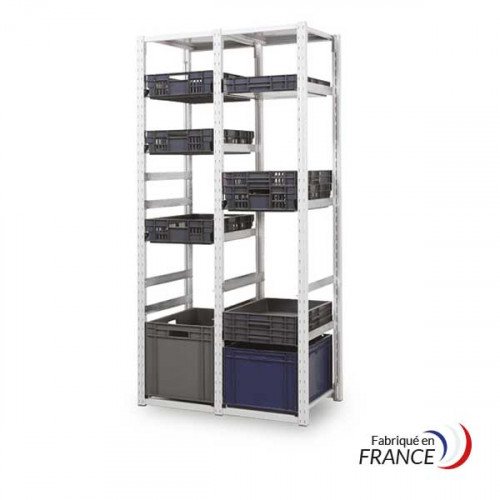
The use of shelving systems specifically designed for these formats, particularly so-called “bin shelving”, perfectly illustrates the integration of Lean Management principles:
- FIFO Method (First In, First Out): Open-back structures allow loading from one side and picking from the other. This natural rotation is critical for perishable or sensitive products, ensuring that the oldest stock is always used first.
- Space densification: By adjusting rails as close as possible to bin height (often in 25 mm increments), “empty storage” is eliminated, maximising usable volume.
Ergonomics and risk prevention (MSDs)
Shelving is the primary interface between workers and loads. An unsuitable system is a major source of musculoskeletal disorders (MSDs) and workplace accidents.
For QHSE managers (Quality, Health, Safety, Environment), equipment selection must meet precise criteria:
- Accessibility: Well-designed shelving limits extreme postures (arms raised above shoulders or bent backs). Drawer systems and pull-out shelves offer practical solutions for easier picking.
- Load safety: Beyond rated load capacity (which must be strictly respected and clearly displayed), the presence of stops, safety pins, and stable uprights is essential to prevent falling objects, a major risk in both warehouses and offices.
Real estate optimisation: Exploiting volume, not just floor area
The cost per square metre—whether in office or industrial environments—continues to rise. A common mistake is to focus solely on floor space, while real potential lies in vertical density.
Several technical strategies make it possible to “push back the walls” without construction work:
- Platforms and mezzanines: They double usable space by taking advantage of ceiling height.
- Mobile shelving systems: Particularly relevant for archives or slow-moving stock, these rail-mounted systems eliminate unnecessary aisles. Space savings can reach up to 95% compared with traditional fixed storage.
A structure for every profession
There is no universal solution. Investment durability depends on matching materials to their environment:
- Industrial environments and workshops: Galvanised or painted steel is required to withstand impacts and heavy loads (pallets, engines).
- Long load management: Profiles, pipes, or planks require cantilever systems for safe horizontal or vertical storage.
- Office and cultural sectors: Here, aesthetics and modularity are key for integration into offices or museum reserves, with adaptability to specific formats (hanging files, archive boxes, artworks).
Towards a space audit
Installing professional shelving should not be a forced expense, but a carefully considered investment. The challenge for organisations is to move from a stacking mindset to a flow-oriented approach.
Key Questions Before Renewing Your Equipment :
Reliability
Does my current storage system contribute to picking errors ?
Ergonomics & Safety
Do my employees have to perform unnecessary or risky movements to access materials ?
Profitability
Am I paying rent and heating costs to store “empty space” ?
A detailed analysis of these needs, supported by space-planning specialists, often makes it possible to transform spatial constraints into a genuine competitive advantage.